
Introduction
Sending money across borders can be slow, expensive, and frustrating. For businesses that work with international customers, even a small payment delay can create problems. In Latin America, where people and companies often deal with currency changes and rising living costs, finding better ways to move money has become increasingly important.
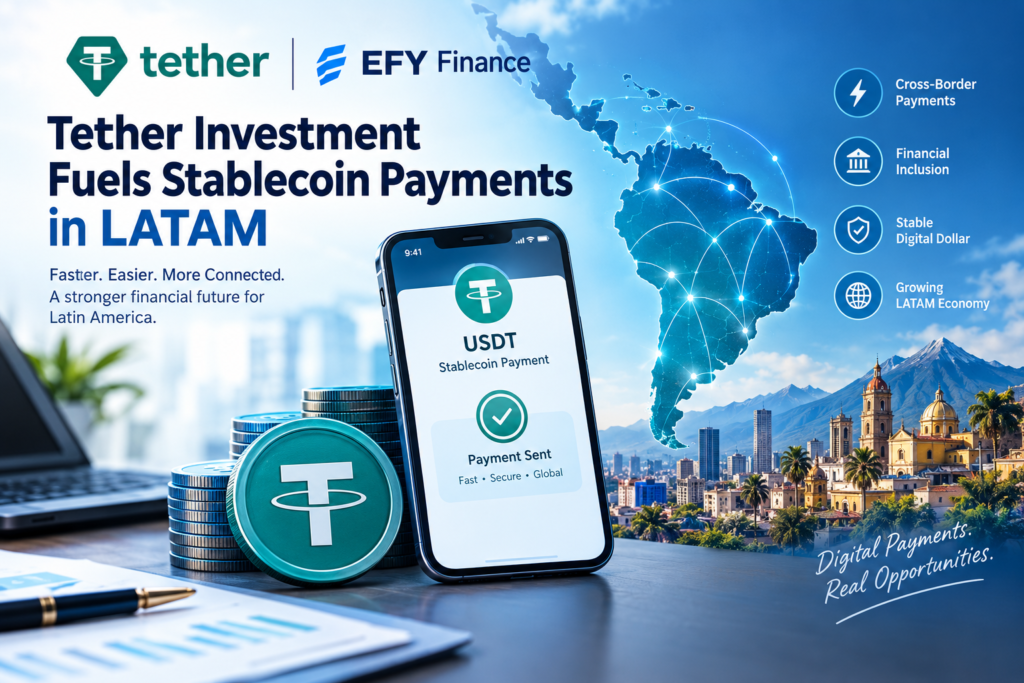
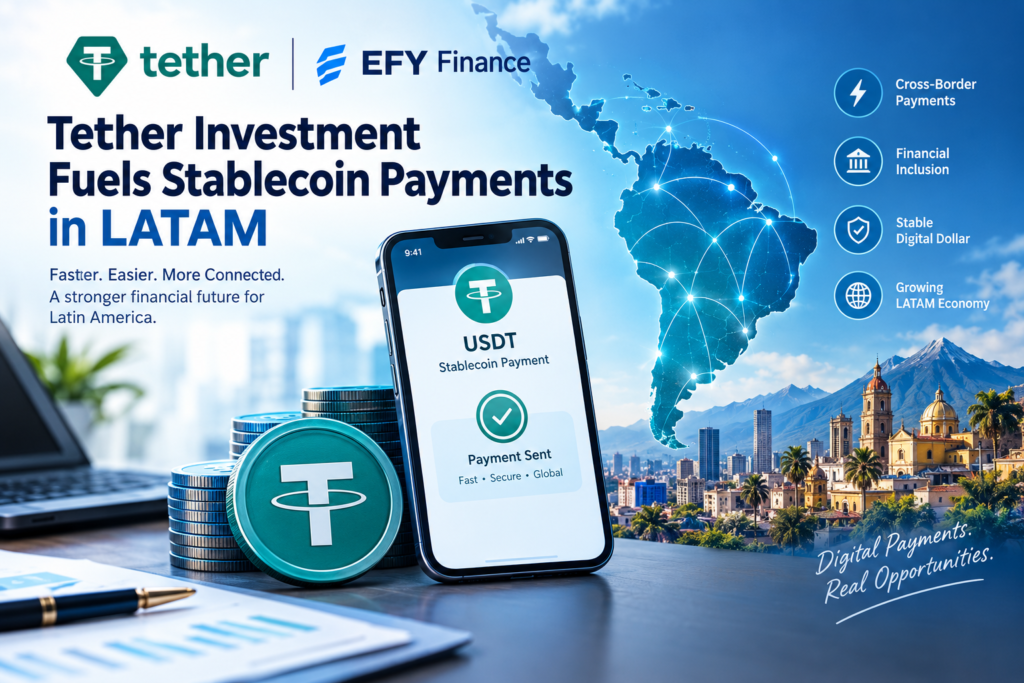
Tether is taking another step toward making digital dollar payments more useful in the region. On October 13, 2026, the company announced an investment in EFY Finance, a financial technology company that connects stablecoin payments with traditional banking services across Latin America. The investment aims to expand the use of Tether’s USD₮ and USA₮ digital currencies among businesses and financial institutions. Financial terms of the investment were not disclosed. “Source: Tether’s official announcement”
But what does this deal actually mean? How can stablecoins help people and businesses send money? And what challenges could slow their growth?
Let’s take a closer look.
What Is Tether, and Why Does It Matter?
Tether is a company known for issuing USD₮, commonly called USDT. USDT is a stablecoin designed to maintain a value close to one U.S. dollar.
Unlike Bitcoin, whose market price can change sharply in a short period, USDT aims to keep a more stable value by being linked to the U.S. dollar. This makes it useful for people who want to transfer digital dollars without taking on the same price fluctuations associated with many other cryptocurrencies.
For example, imagine a business owner in Colombia who needs to pay a supplier in another country. A traditional international bank transfer may involve several banks, currency conversions, and processing delays.
With stablecoins, the business may be able to send digital dollars through a supported blockchain network. The receiver can then convert those funds into local currency through an available financial service.
The exact cost and speed depend on the blockchain, the service provider, and the countries involved.
Stablecoins do not remove every problem in international payments, but they offer another way to move money.
What Is the Tether–EFY Finance Investment About?
EFY Finance provides financial infrastructure that connects digital assets with traditional financial systems. Its services include cross-border payments, financial accounts, digital asset custody, wallets, cards, and ways to convert between stablecoins and local currencies.
According to Tether’s announcement, EFY Finance supports more than 25,000 active individual and business accounts. It also offers settlement into local accounts across 17 countries and operates across more than 12 currencies and payment corridors.
The company is licensed as a Digital Asset Service Provider in El Salvador.
Tether’s investment is intended to help EFY Finance expand institutional use of USD₮ and USA₮. The companies are focusing on connecting digital dollar payments with the banking services that businesses already use.
The announcement highlights markets including Bolivia, Colombia, Mexico, El Salvador, Panama, and Ecuador.
The main idea is simple: digital payments become more practical when people can move money between a digital wallet and a regular financial account without unnecessary complications.
Why Is Latin America Important for Stablecoin Payments?
Latin America has several economic and financial conditions that make stablecoins worth watching.
1. Currency Volatility and Inflation
Some countries in Latin America have experienced periods of high inflation or significant currency depreciation. When local money loses purchasing power, people may look for ways to hold part of their savings in another currency.
The U.S. dollar is an important reference currency for international trade and savings in many parts of the world.
USDT gives eligible users a way to hold a digital asset designed to track the dollar without necessarily opening a traditional U.S. dollar bank account.
However, access depends on local laws, the service provider, and the user’s circumstances. USDT is not the same as holding insured U.S. bank deposits, and its value is not guaranteed by the U.S. government.
2. International Payments
Businesses often need to pay overseas suppliers, contractors, employees, or service providers.
Traditional transfers can require multiple intermediaries. Depending on the payment route, they may also involve currency conversion fees and delays.
Stablecoins can provide an alternative settlement method. A business can send digital dollars to a supported wallet, while the receiver may convert them into local money through a suitable payment provider.
This could make some international transactions easier to manage.
3. Access to Digital Financial Services
Not everyone has easy access to affordable international banking services. Some individuals and small businesses face account restrictions, expensive transfer fees, or complicated paperwork.
Mobile wallets and digital payment platforms may offer additional ways to access financial services.
Still, stablecoins require internet access, a compatible wallet or service, and enough knowledge to avoid scams. They are not a complete replacement for banking services.
How Can Stablecoin Payments Work in Real Life?
Consider a small company in Mexico that provides online services to a customer in another country.
The customer wants to pay the company in U.S. dollars, but a traditional bank transfer may take time or involve fees.
A stablecoin payment could follow these steps:
1. Purchase or receive stablecoins: The sender obtains USDT through a supported provider.
2. Transfer the funds: The sender transfers the stablecoins to the recipient’s compatible wallet or payment service.
3. Confirm the transaction: The recipient checks that the funds arrived on the correct blockchain network.
4. Convert the money: If needed, the recipient exchanges the stablecoins for local currency through a supported provider.
5. Receive local funds: The money may then be settled into a local bank account, depending on the service and country.
A platform such as EFY Finance aims to help connect these steps with local financial systems.
The process is not automatically free or instant. Network fees, exchange rates, provider charges, compliance checks, and bank processing times can affect the final result.
Even so, this type of infrastructure could offer businesses another option for handling international payments.
What Benefits Could Businesses Gain?
Tether’s investment may support several practical uses for companies operating across borders.
Faster Settlement
Some blockchain transfers can settle within minutes or less, depending on the network and transaction conditions. That may be faster than certain international bank transfers.
Faster settlement can help companies manage cash flow and pay suppliers sooner.
Better Payment Flexibility
Businesses may be able to send or receive digital dollars outside the normal operating hours of some traditional payment systems.
However, converting stablecoins into local currency or withdrawing money through a bank may still depend on the provider’s operating hours and processing rules.
Easier Cross-Border Operations
Companies working with customers in several countries may prefer a payment method that works across different markets.
Stablecoins could help reduce the number of separate payment arrangements a business needs. The actual benefits depend on whether its partners, financial providers, and local regulations support the service.
More Options for Small Businesses
Small businesses and independent professionals sometimes struggle with the costs of receiving international payments.
A well-designed stablecoin payment service could offer another route for receiving money from overseas customers.
The key question is whether the total cost is genuinely lower after accounting for conversion fees, withdrawal charges, and compliance requirements.
What Does This Mean for Ordinary People?
The benefits may extend beyond large companies.
Imagine someone living in Colombia who receives money from a family member working abroad. Depending on the available service, stablecoins could help move digital dollars across borders before the recipient converts them into local currency.
A freelancer working with international clients might also use a supported digital payment platform to receive payments.
In countries where access to foreign currency is difficult, stablecoins may provide another way to access dollar-linked value.
However, users should compare available services carefully. Traditional remittance providers, banks, and local payment networks may sometimes be cheaper or more convenient.
Stablecoins are a payment option, not a guarantee of savings.
The Risks and Challenges of Stablecoin Adoption
Although stablecoins offer potential benefits, they also come with important risks.
Regulatory Requirements
Each country has its own rules for cryptocurrencies, digital assets, banking, and money transfers. A service that operates legally in one country may face different requirements in another.
Financial companies must consider licensing, customer verification, anti-money-laundering rules, reporting obligations, and other applicable laws.
As governments develop clearer regulations, businesses will need to understand which services are permitted in each market.
Security and Scams
Crypto transactions can be difficult or impossible to reverse after they are confirmed. Sending funds to the wrong wallet address or falling for a fake payment request can lead to permanent losses.
Users should verify wallet addresses, use trusted providers, and protect their account credentials.
Stablecoin and Platform Risk
USDT is designed to maintain a value close to one U.S. dollar, but its market price can temporarily move away from that target. Users also depend on the issuer’s reserves, redemption arrangements, and the platforms they use.
A payment provider can experience technical problems, freeze accounts where legally required, or limit withdrawals.
Conversion and Liquidity Problems
A digital dollar is useful only if the recipient can access or spend its value.
In some markets, converting USDT into local currency may be expensive or difficult. Liquidity, exchange rates, withdrawal limits, and local banking access can all affect the experience.
For widespread adoption, reliable conversion services are just as important as the blockchain itself.
Why Tether Is Investing in Financial Infrastructure
Tether’s investment in EFY Finance reflects a broader strategy of supporting companies that connect digital assets with real financial services.
Instead of focusing only on buying and selling cryptocurrency, this approach emphasizes practical uses such as payments, business accounts, digital asset custody, and international settlement.
The distinction matters because most businesses do not want to manage complicated blockchain systems themselves. They want to pay suppliers, receive money, manage expenses, and keep accurate financial records.
Infrastructure providers can help connect the technical side of stablecoins with familiar banking services.
If these systems become easier to use and meet local regulatory requirements, more businesses may consider stablecoin payments as part of their financial operations.
However, investment alone does not guarantee adoption. EFY Finance will still need to demonstrate reliable service, competitive costs, effective security, and demand from customers.
What Could Happen Next?
The next stage of stablecoin adoption in Latin America will depend on how well providers solve everyday payment problems.
Businesses will want clear pricing, reliable access to funds, accurate records, and customer support. Financial regulators will continue to focus on consumer protection and compliance.
Banks and payment companies may also develop new partnerships that combine traditional accounts with blockchain-based settlement.
Tether’s investment could help EFY Finance strengthen its services and expand institutional access to USD₮ and USA₮. But the long-term impact will depend on actual usage rather than the announcement alone.
For consumers and businesses, the most important measure of success will be whether these services make payments more affordable, reliable, and accessible.
Final Thoughts
Tether’s investment in EFY Finance is another sign that stablecoins are being developed for more than cryptocurrency trading.
By connecting digital dollar payments with local banking systems, the partnership aims to make cross-border transactions more practical for businesses and financial institutions across Latin America.
The potential benefits include faster settlement, more payment options, and easier access to digital dollars. At the same time, users must consider regulatory rules, security risks, conversion costs, and the possibility that a stablecoin may not always trade at exactly one dollar.
For now, the investment is an important development to watch, not proof that stablecoins will replace traditional banking.
If EFY Finance can combine reliable technology with convenient local payment services, its partnership with Tether could help move stablecoin payments closer to everyday business use.
Disclaimer: This article is for informational and educational purposes only. It does not provide financial, investment, or legal advice. Cryptocurrency and stablecoin services carry risks. Readers should research providers, understand local regulations, and consider their financial circumstances before making decisions.